The Map Is Not the Territory: What a 12th-Century Map in Fez Taught Me About Leadership
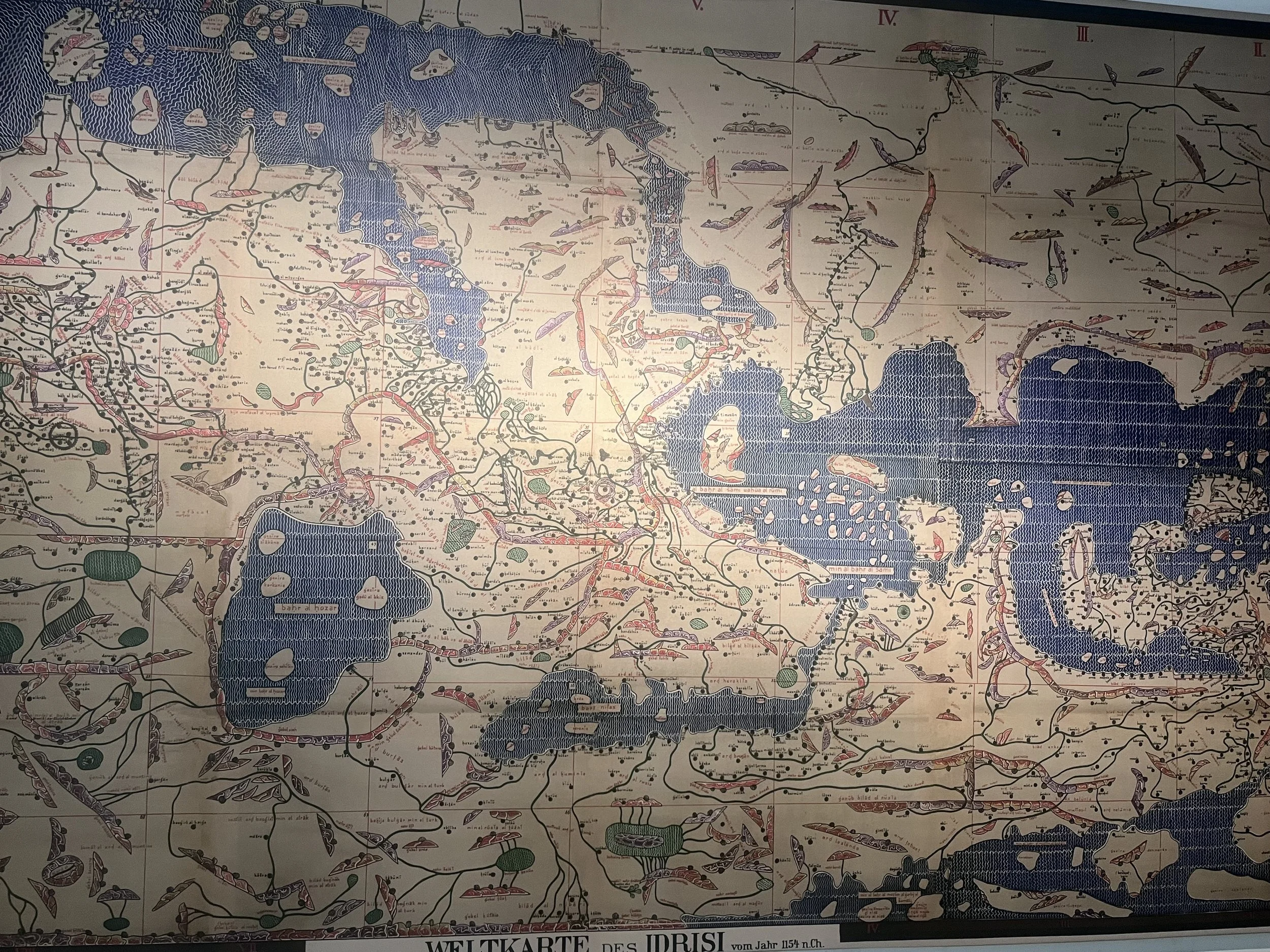
Tabula Rogeriana 1154 by Muhammad Al-Idrisi in Museum of Islamic Arts, Festival Morocco. Photo credit: Authors own
As a leadership facilitator and coach, I ask people to move around and encourage them to ‘see the world from a different place’.
On holiday I got to experience this profoundly and the impact has stayed with me.
I was standing in front of a map in Fez, Morocco when I felt briefly, genuinely lost. South was at the top. The Arabian Peninsula sat where I expected Europe to be. Everything I thought I knew about "up" and "centre" had quietly been someone else's decision, not a fact of nature - and for a few seconds, my own sense of orientation just… went.
The map was a version of the Tabula Rogeriana - completed in 1154 by the geographer Muhammad al-Idrisi, commissioned by the Norman King Roger II of Sicily. There's a lovely thread running under the surface of this: al-Idrisi descended from the Idrisid dynasty - the very dynasty that founded Fez. In a real sense, that map had come home.
Al-Idrisi built his map by interviewing experienced travellers, keeping only what independent accounts agreed on, and leaving out what was contradictory. It stayed the most accurate map of the known world for the next three centuries. And it is oriented south-up, not because anyone had it "backwards," but because north-up is a convention - one that only feels neutral to those of us who were raised on it.
Around a century and a half later, in 1300, England's Hereford Cathedral produced its own picture of the world: the Mappa Mundi. Jerusalem sat at the centre. God sat above it. It wasn't trying to be geographically accurate - it was theology, laid out as geography, a moral map of salvation more than a navigational one.
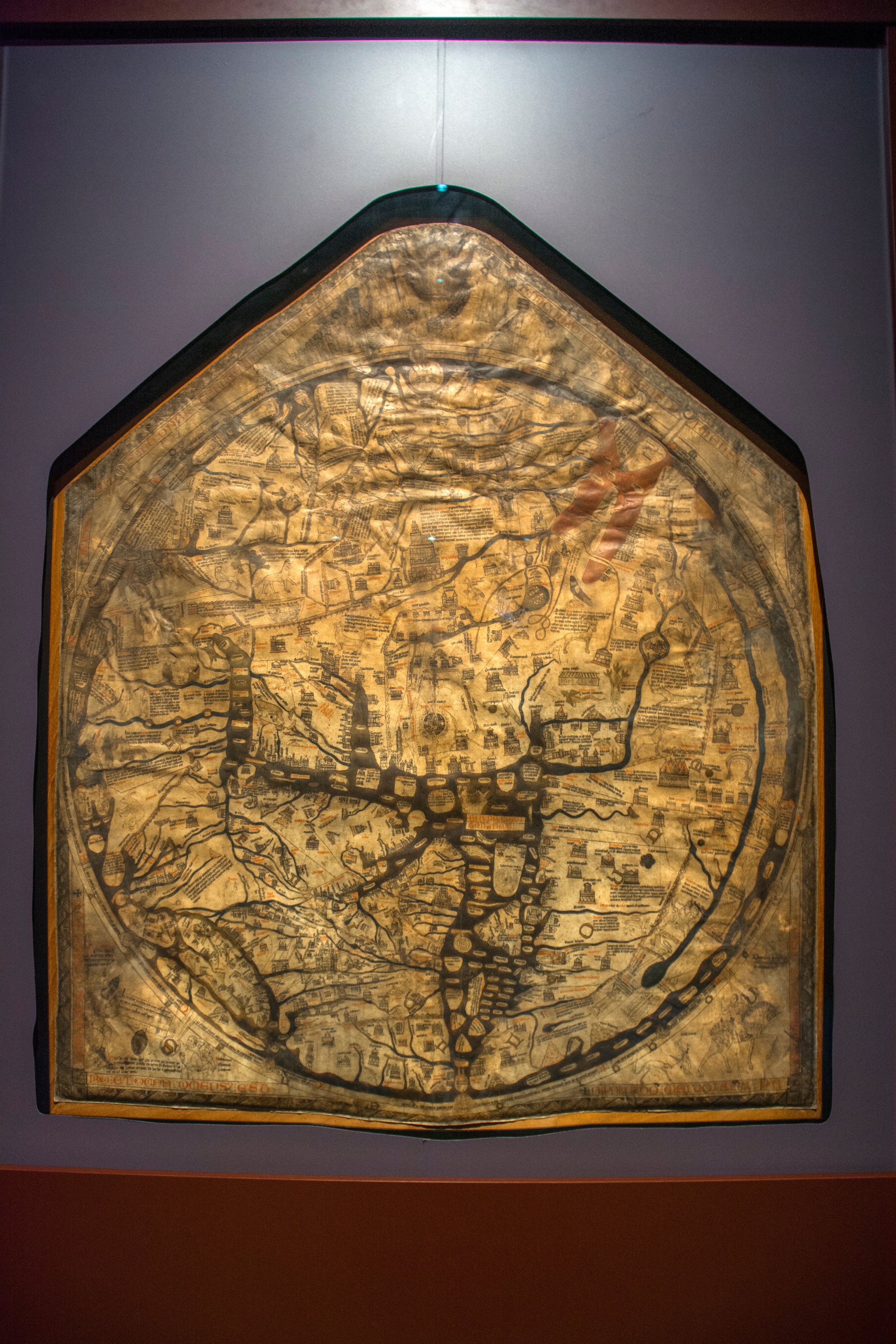
Mappa Mundi Hereford Cathedral Photo Credit: Shutterstock
Two maps.
Roughly the same window of history.
Entirely different ideas of what a map is even for.
Differing perspectives.
What each map did with what it didn't know is the part that stayed with me longest.
Where al-Idrisi's knowledge ran out, he stopped. He left the gap open rather than filling it with confidence he didn't have.
Where the Mappa Mundi's knowledge ran out, the makers filled the edges with dragons, sea serpents, dog-headed men - not decoration, but a way of making the map feel complete when the knowledge wasn't there.
Two different relationships with not-knowing. One holds the blank space open. The other can't tolerate it, and reaches for a story instead - usually based on fear - so the gap disappears.
I think leaders do both of these things, faced with complexity.
The map is not the territory.
We all have our own maps of our world.
Every leader is working from one: an organisation chart, a sense of "how this place works," how power dynamics work in practice, a picture of a colleague or a service built from a handful of interactions.It is never the whole territory. It was always drawn from somewhere, by someone, oriented the way they were taught "up" was - and it's just as easy for any of us to mistake our map for the world as it was for the early cartographers.
And I think we do the same thing with "advanced" and "primitive," with whose knowledge counts. The human brain looks to simplify complexity. It's tempting to reach for a simple story here - look how sophisticated the Islamic world was - but the sharper truth is stranger than that: al-Idrisi was doing something closer to what we'd now call empirical method, while the Mappa Mundi's makers weren't attempting that at all; they were doing something else entirely, and doing it well by their own standards.
We tend to judge "knowledge" by whichever standard our own tradition already privileges, and quietly miss what the other tradition was actually built to do.
Which brings me to the blank spaces on your own map.
Where do you fill the unknown with a dragon - a confident story about what a colleague "must be" thinking, what a team "must be" struggling with, what a service or organisation "must be" like - rather than admitting you haven't actually gone and asked? Have you been curious enough to understand?
And where might you, instead, do what al-Idrisi did: hold the gap open, say "I don't know yet" out loud, and go find someone standing on different ground who can tell you what the territory looks like from where they are?
How much do leaders value different perspectives and orientations that may give insight and innovation, challenges and opportunities?
How often do leaders hold the tension of difference as well as common ground – to allow new solutions to emerge?
And what about the dragons? Psychologically safe teams are, among other things, teams where nobody has to draw dragons to cover the gap. Where "I don't know" is sayable. Where the leader goes looking for other people's maps, not to replace their own, but because the territory only comes fully into view once you've held a few different maps of it side by side.
A small, specific practice for this week: notice one place where you've drawn a dragon - a story you've told yourself, with real confidence, about someone or something you actually haven't checked. Then go and ask them what their map looks like.
You may find south is at the top of theirs. That's not a mistake. It's just where they're standing.